Travel Technology
How to Build an Online Travel Agency (OTA) Platform
Maria Zargar 13 min read
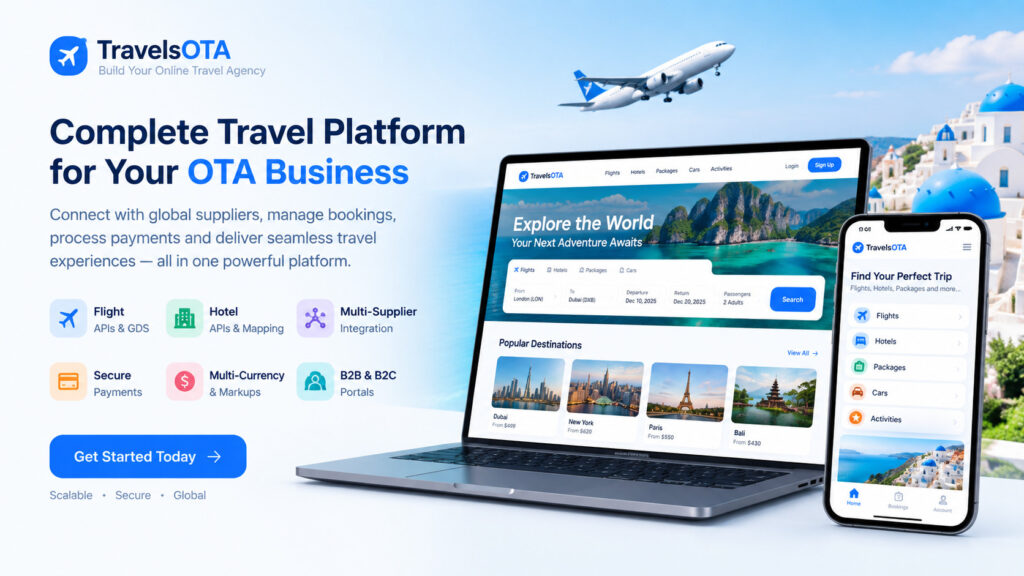
Building an online travel agency is no longer just about creating a website where customers can search for flights or hotels.
A modern OTA needs a technology ecosystem capable of connecting travel suppliers, processing searches, displaying availability, validating prices, managing bookings, accepting payments and supporting post-booking services.
The technology behind the platform may include:
- Travel APIs
- Flight APIs
- Hotel APIs
- GDS connectivity
- NDC connectivity
- Booking engines
- Supplier integrations
- Payment gateways
- Markup management
- Multi-currency functionality
- Agent portals
- B2B travel functionality
- B2C booking experiences
If you’re researching travel API integration, this is one of the most important technical foundations of a modern OTA.
Before choosing your technology stack, it is also useful to understand what a GDS is and how it works for travel agencies because GDS connectivity can form an important part of airline and travel distribution.
For airline distribution, NDC is another technology businesses should understand. IATA describes NDC as an XML-based data-exchange standard based on Offer and Order management. Learn more about IATA NDC through the official IATA documentation.
This guide explains how to build an online travel agency from the initial business model through architecture, APIs, booking engines, supplier connectivity, payments, B2B functionality and launch.
What Is an Online Travel Agency?
An online travel agency (OTA) is a digital platform that allows travelers or travel businesses to search, compare and book travel products online.
Depending on its business model, an OTA can sell:
- Flights
- Hotels
- Packages
- Tours
- Transfers
- Car rentals
- Activities
- eSIMs
- Other travel products
The OTA usually connects its customer-facing website or application with external inventory providers.
A simplified model looks like:
Traveler / Agent
↓
OTA Website or Mobile App
↓
Booking Engine
↓
Travel API / Integration Layer
↓
GDS | NDC | Airlines | Hotels | Suppliers
↓
Travel Inventory
The platform handles the customer or agent experience while the integration layer communicates with external travel systems.
How Does an Online Travel Agency Work?
A typical OTA workflow starts when a user searches for a travel product.
For example:
London → Dubai
Departure: December 10
Return: December 20
Passengers: 2 adults
The booking platform sends this information to its connected flight suppliers.
The suppliers return available offers.
The OTA then:
- Processes the supplier response.
- Normalizes the data.
- Applies pricing rules.
- Displays results.
- Allows the user to select an offer.
- Validates pricing where required.
- Collects traveler information.
- Processes payment.
- Creates the booking.
- Stores confirmation information.
For businesses planning the technical side of this process, our Travel API Integration guide explains how search, supplier connectivity, normalization, pricing and booking can be structured.
Choosing Your OTA Business Model
Before writing code, determine what type of OTA you want to build.
Your business model affects the architecture, features, supplier relationships and pricing system.
B2C OTA
A B2C OTA sells directly to travelers.
Typical features include:
- Customer registration
- Flight search
- Hotel search
- Online payment
- Booking management
- Customer dashboard
- Cancellation requests
- Email notifications
- Promotional offers
B2B Travel Portal
A B2B travel portal is designed for travel agencies, agents, corporate customers or other travel businesses.
It may require:
- Agent registration
- Agent approval
- Agent dashboard
- Net rates
- Markups
- Commission management
- Credit limits
- Wallet/balance
- Booking history
- Agent reports
- Invoices
- White-label functionality
Hybrid B2B + B2C OTA
Some travel businesses operate both models.
For example:
B2C
Traveler → Website → Booking
B2B
Travel Agent → Agent Portal → Booking
Both channels can share the same backend infrastructure and supplier integrations while using different interfaces and pricing rules.
Travel API Integration for OTA Development
Travel API integration is one of the core technologies behind modern OTA platforms.
APIs can connect the platform with:
- Airlines
- Hotels
- GDS providers
- NDC providers
- Travel aggregators
- Transfers
- Activities
- Car rental providers
The API layer can retrieve availability, pricing and booking information and return it to the OTA’s booking engine.
For a deeper technical explanation, see the complete Travel API Integration guide.
A scalable integration architecture should also allow multiple suppliers to be connected through a centralized layer instead of exposing individual supplier APIs directly to the frontend.
GDS and NDC Integration
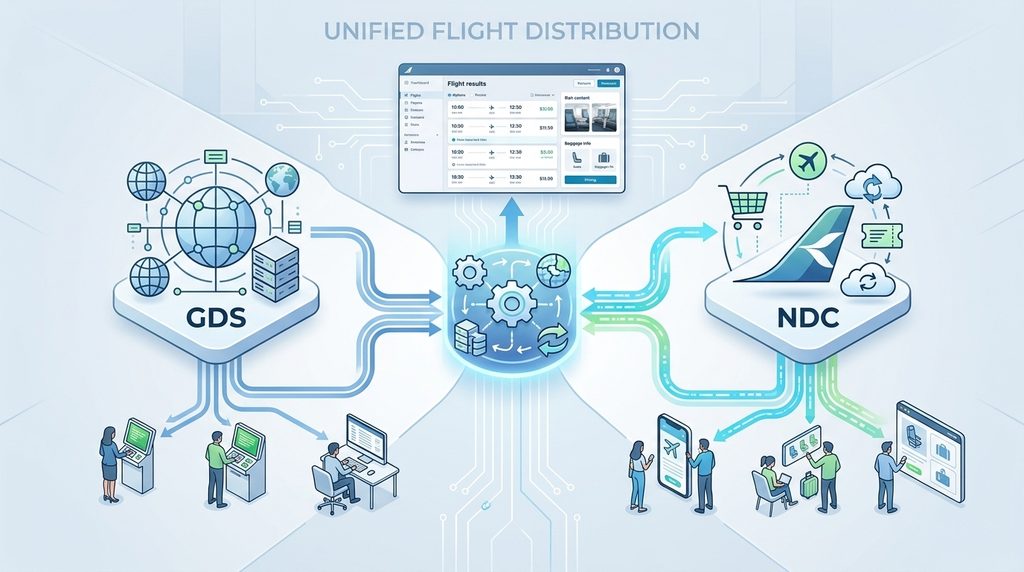
Flight distribution can involve both GDS and NDC connectivity.
A GDS provides travel distribution capabilities used by travel sellers, while NDC is an IATA-supported standard focused on airline Offer and Order management.
If you’re comparing these technologies, see GDS vs NDC for travel agencies.
For authoritative technical information, IATA’s official NDC documentation explains the NDC standard and its role in airline retailing.
IATA’s documentation also describes NDC capabilities covering shopping, order creation, servicing, cancellation, payments and refunds.
Flight API Integration
A flight booking platform may use direct airline APIs, GDS connectivity, NDC connectivity or other flight-content providers.
Typical flight functionality includes:
- Flight search
- Availability
- Pricing
- Fare rules
- Baggage
- Seats
- Ancillaries
- Booking
- Ticketing
- Cancellation
- Exchanges
For a supplier-specific implementation example, see the Travelport Flight API Integration guide.
For current technical documentation, Travelport’s official developer resources provide information about its flight APIs, authentication, search and booking workflows.
Explore Travelport’s official flight API documentation for supplier-specific technical details.
Hotel API Integration
Hotel connectivity is another important component of an OTA.
A hotel API may provide:
- Hotel search
- Availability
- Room rates
- Room types
- Amenities
- Images
- Policies
- Cancellation conditions
- Booking
- Cancellation
Hotel integration can become more complex when multiple suppliers provide the same properties using different IDs, names and room structures.
This is why hotel mapping and normalization should be part of the architecture.
For an example of supplier-specific hotel connectivity, see the Hotelbeds API Integration guide.
Building the OTA Booking Engine
The booking engine turns supplier inventory into a usable booking experience.
A flight booking workflow may look like:
Search
↓
Results
↓
Filters
↓
Offer Selection
↓
Price Validation
↓
Traveler Details
↓
Payment
↓
Booking
↓
Ticket / Confirmation
A hotel workflow can follow:
Destination
↓
Dates
↓
Hotels
↓
Rooms
↓
Rate Selection
↓
Guest Details
↓
Payment
↓
Confirmation
The booking engine should communicate with the API layer rather than connecting the frontend directly to every supplier.
Multi-Supplier OTA Architecture
A scalable OTA should use a centralized integration layer.
Customer / Agent
       ↓
Website / Mobile App
       ↓
Booking Engine
       ↓
API Gateway
       ↓
Integration Layer
       ↓
 ┌─────┼──────┬──────┐
 ↓     ↓      ↓      ↓
GDS   NDC   Flight   Hotel
            APIs     APIs
 ↓     ↓      ↓      ↓
      Suppliers
The integration layer can manage:
- Authentication
- Supplier requests
- Response normalization
- Error handling
- Logging
- Monitoring
- Pricing
- Markups
- Currency conversion
- Supplier routing
This architecture also makes future supplier expansion easier.
Travelport Integration Example
For an OTA that requires Travelport connectivity, the integration may involve flight search, pricing, booking, ticketing and post-booking workflows.
Travelport’s current documentation states that its flight APIs provide REST/JSON-based interfaces and cover air search, booking and reservation management.
See the Travelport Flight API integration guide for the TravelSOTA-specific implementation topic, and use Travelport’s official developer documentation when validating current API behavior.
This combination gives the article both:
- an internal commercial/educational link, and
- an authoritative external technical source.
Hotel Supplier Integration
The same architecture can be used for hotel suppliers.
For example:
OTA
↓
Hotel Integration Layer
↓
Hotel Supplier
↓
Search
↓
Availability
↓
Rate
↓
Booking
↓
Confirmation
When several hotel providers are connected, the platform should normalize their responses before presenting them to users.
This is particularly important for property and room mapping.
See the Hotelbeds API integration guide for a dedicated supplier example.
Markup and Commission Management
A B2C OTA may use a retail markup, while a B2B platform may need agent-specific pricing.
For example:
Supplier price: $100
Markup: 10%
Customer price: $110
A B2B platform could use different rules:
- Agent A → 5%
- Agent B → 8%
- Agent C → 10%
The pricing engine can also support:
- Fixed markup
- Percentage markup
- Commission
- Product-specific pricing
- Supplier-specific pricing
- Agent-specific pricing
- Customer-specific pricing
Pricing should be controlled centrally so the same rules can be applied consistently across different booking channels.
Payment Integration
An OTA needs a secure payment workflow.
Depending on the business model, the platform may support:
- Credit/debit cards
- Payment gateways
- Bank payments
- Wallets
- Refunds
- Partial refunds
- Transaction records
The booking architecture should account for situations where payment succeeds but the supplier booking fails.
For example:
Payment Successful
       ↓
Supplier Booking
       ↓
Booking Failed
       ↓
Exception / Reconciliation
This is why payment and booking systems should communicate through clearly defined transaction states.
B2B Agent Portal
A B2B OTA requires functionality beyond a normal consumer website.
An agent portal can provide:
- Agent login
- Search
- Booking
- Markup management
- Commission
- Wallet
- Credit
- Customer management
- Reports
- Invoices
- Booking history
A typical workflow is:
Agent Login
↓
Search Inventory
↓
Apply Agent Pricing
↓
Select Product
↓
Traveler Details
↓
Payment / Credit
↓
Booking Confirmation
This allows the same supplier infrastructure to serve multiple travel agencies.
Multi-Currency OTA Platform
International OTAs may need to support currencies such as:
- USD
- EUR
- GBP
- AED
- SAR
- PKR
The platform should distinguish between supplier currency and customer display currency.
For example:
Supplier Price: USD 100
Display Currency: EUR
Customer Price: Converted EUR amount
The conversion logic should be centralized so pricing remains consistent across the platform.
OTA Admin Dashboard
An administration dashboard gives the business control over the platform.
It may include:
User Management
- Customers
- Agents
- Administrators
Supplier Management
- Flight suppliers
- Hotel suppliers
- GDS
- NDC
- API credentials
Booking Management
- Confirmed
- Pending
- Cancelled
- Failed
Pricing
- Markups
- Commissions
- Discounts
Payments
- Transactions
- Refunds
- Failed payments
Reports
- Revenue
- Bookings
- Supplier performance
- Agent performance
Security and API Authentication
OTA platforms process sensitive customer, booking and payment-related information.
Depending on the supplier, APIs may use:
- OAuth 2.0
- API keys
- Tokens
- Client credentials
- Signed requests
Travelport’s current documentation describes OAuth 2.0 authentication for its TripServices APIs. See Travelport’s official authentication documentation.
Your OTA should also use:
- HTTPS
- Secure secret storage
- Role-based permissions
- Access control
- Environment separation
- Monitoring
- Logging
- Secure payment processing
Never expose supplier credentials in frontend JavaScript.
Testing an Online Travel Agency
Before launch, test the complete booking lifecycle.
Functional Testing
Test:
- Search
- Filters
- Pricing
- Booking
- Payment
- Confirmation
- Cancellation
API Testing
Test:
- Authentication
- Request validation
- Response handling
- Timeout
- Errors
- Rate limits
Booking Testing
Test:
- Successful booking
- Price changes
- Supplier failure
- Availability changes
- Duplicate bookings
- Cancellation
Payment Testing
Test:
- Successful payment
- Failed payment
- Duplicate transaction
- Refund
- Partial refund
Testing should cover both the normal customer journey and failure scenarios.
Common OTA Development Mistakes
1. Building Only the Frontend
A visually impressive website does not solve supplier connectivity or booking problems.
2. Directly Connecting Every Supplier to the Frontend
This can make the platform difficult to maintain.
3. Ignoring Price Validation
Travel inventory can change between search and booking.
4. No Data Normalization
Different suppliers may return different structures.
5. Weak Error Handling
Supplier failures should be categorized and handled gracefully.
6. No Reconciliation
Payment and supplier booking status can become inconsistent.
7. Ignoring B2B Requirements
B2B portals need different pricing, permissions and reporting.
How Much Does It Cost to Build an OTA?
OTA development costs depend on the actual scope.
Key factors include:
| Component | Impact |
|---|---|
| Website | Medium |
| Flight APIs | Medium–High |
| Hotel APIs | Medium |
| GDS | Medium–High |
| NDC | Provider-dependent |
| Multiple suppliers | High |
| B2B portal | Medium–High |
| Payment integration | Medium |
| Mobile apps | Medium–High |
| Admin dashboard | Medium |
| Custom workflows | High |
| Testing | Medium |
| Maintenance | Recurring |
Rather than using a fixed price estimate without knowing the requirements, define the products, suppliers, channels and booking workflows first.
How Long Does It Take to Build an OTA?
There is no universal timeline.
The development period depends on:
- Number of suppliers
- Number of products
- B2B/B2C requirements
- API complexity
- Payment integration
- Custom functionality
- Mobile applications
- Data mapping
- Testing
- Security requirements
A simple MVP is very different from a multi-supplier OTA supporting flights, hotels, B2B agents and multiple payment methods.
Why Choose a Scalable OTA Architecture?
A travel business may begin with:
Flights + Hotels
and later add:
GDS + NDC + Transfers + Cars + Activities + eSIM + Visa + Mobile Apps
The architecture should therefore be modular.
A supplier abstraction layer makes it easier to add new providers without rewriting the customer-facing platform.
This is one reason travel API integration should be treated as a core architectural layer rather than simply another website feature.
TravelsOTA for OTA Development
TravelsOTA focuses on travel technology solutions for businesses developing online travel platforms.
Depending on business requirements, an OTA platform can involve:
- Travel API integration
- Flight connectivity
- Hotel connectivity
- GDS integration
- NDC integration
- Booking engines
- B2B travel portals
- B2C booking platforms
- Supplier integrations
- Agent portals
- Markup management
- Payment integration
- Multi-currency functionality
Businesses evaluating the platform can explore TravelsOTA or view the TravelsOTA demo.
Final Checklist for Building an OTA
Before launch, make sure your platform has:
- Defined B2B/B2C business model
- Selected travel products
- Supplier agreements
- API credentials
- Sandbox access
- Booking engine
- API integration layer
- Data normalization
- Hotel mapping where required
- Search
- Availability
- Price validation
- Booking
- Payment
- Confirmation
- Cancellation
- Refund workflow
- Markup management
- Multi-currency
- Agent portal if B2B
- Admin dashboard
- Monitoring
- Security testing
- Performance testing
- End-to-end booking testing
Build Your Travel Business With TravelsOTA
Launch and manage your online travel platform with flight and hotel connectivity, travel APIs, GDS and NDC integrations, booking engines, B2B portals, payments, and centralized supplier management.
Explore TravelsOTA → View Live Demo ✓ Scalable Platform ✓ Travel API Integrations ✓ B2B & B2C SolutionsConclusion
Building an online travel agency requires more than launching a travel website.
A scalable OTA combines travel APIs, supplier connectivity, GDS/NDC where appropriate, booking engines, pricing, payments, booking management, security and monitoring into one connected technology ecosystem.
The right architecture should also make it possible to add new suppliers and travel products as the business grows.
If you’re planning an OTA, start by defining your business model, target market, travel products and supplier requirements. Then build the technical architecture around those requirements.
To explore a travel technology platform, visit TravelsOTA or view the TravelsOTA demo.
Frequently Asked Questions About Building an OTA Platform
1. What is an online travel agency (OTA) platform?
An online travel agency (OTA) platform is a digital travel booking system that allows customers or travel agents to search, compare, book, and pay for travel services such as flights, hotels, tours, transfers, and car rentals.
2. How do you build an online travel agency platform?
Building an OTA platform typically involves defining the business model, selecting the required travel inventory, integrating flight and hotel APIs, connecting GDS or NDC providers, developing a booking engine, integrating payments, implementing markup and commission rules, and creating admin and agent portals.
3. What APIs are required for an OTA platform?
Common APIs include flight APIs, hotel APIs, GDS APIs, NDC APIs, payment APIs, transfer APIs, car rental APIs, activities APIs, and other supplier APIs. The required integrations depend on the OTA’s products and target markets.
4. What is the difference between GDS and NDC for an OTA?
GDS platforms provide access to travel inventory and distribution services from multiple suppliers, while NDC is an airline distribution standard designed to support richer airline content and more flexible retailing. An OTA may use GDS, NDC, or both depending on its airline distribution strategy.
5. Can an OTA platform connect multiple travel suppliers?
Yes. A scalable OTA architecture can connect multiple flight, hotel, GDS, NDC, and other travel suppliers through an API integration layer. Supplier responses can be normalized so the booking engine can present inventory through a consistent interface.
6. How much does it cost to build an OTA platform?
OTA development costs vary based on platform complexity, integrations, number of suppliers, booking features, payment requirements, portals, customization, security, and infrastructure. A basic platform generally requires less investment than a multi-supplier B2B and B2C OTA ecosystem.
7. How long does it take to build an OTA platform?
Development time depends on the number of features and integrations. A basic OTA can be developed faster than a complex platform requiring multiple supplier integrations, advanced booking workflows, B2B portals, payment systems, multi-currency support, and custom business rules.
8. Can an OTA support both B2B and B2C bookings?
Yes. An OTA can support both B2B and B2C models using separate customer and agent experiences. B2B functionality can include agent accounts, markup management, credit limits, commissions, booking management, and dedicated agent portals.
9. What features should an OTA booking engine include?
An OTA booking engine can include search, availability, filtering, pricing, passenger information, booking, payment processing, ticketing, vouchers, cancellation workflows, booking management, supplier connectivity, and customer notifications.
10. How can TravelsOTA help build an OTA platform?
TravelsOTA provides travel technology solutions for building and scaling online travel platforms, including booking engines, travel API integrations, supplier connectivity, B2B and B2C portals, payment integration, multi-currency support, and travel inventory management.
Keep reading

Travel Technology
B2B Travel Payments for Airlines, Travels Agencies and OTAs: A Complete Guide
B2B travel payments play a critical role in the way airlines, travel agencies, and online travel agencies (OTAs) manage bookings, supplier settlements, and international transactions. As travel businesses expand into new
Maria Zargar ·

Travel Technology
Top Travel Agencies in the World: Best Travel Companies Booking Platforms in 2026
Planning a trip today can mean choosing between a traditional travel agency, an online travel agency (OTA), a tour operator, or a specialized corporate travel company. The right option depends on what you need: flights,
Maria Zargar ·
Travel Technology
Travel API Integration: Complete Guide for OTAs, Agencies & Travel Businesses
Introduction Travel businesses increasingly depend on technology to connect customers with flights, hotels, transfers, tours, car rentals and other travel products. A modern online travel agency (OTA) is not simply a web
Maria Zargar ·
Need help with your travel platform?
Email us about booking platforms, supplier APIs, websites and mobile apps.