Travel Technology
Travel API Integration: Complete Guide for OTAs, Agencies & Travel Businesses
Maria Zargar 13 min read
Introduction
Travel businesses increasingly depend on technology to connect customers with flights, hotels, transfers, tours, car rentals and other travel products.
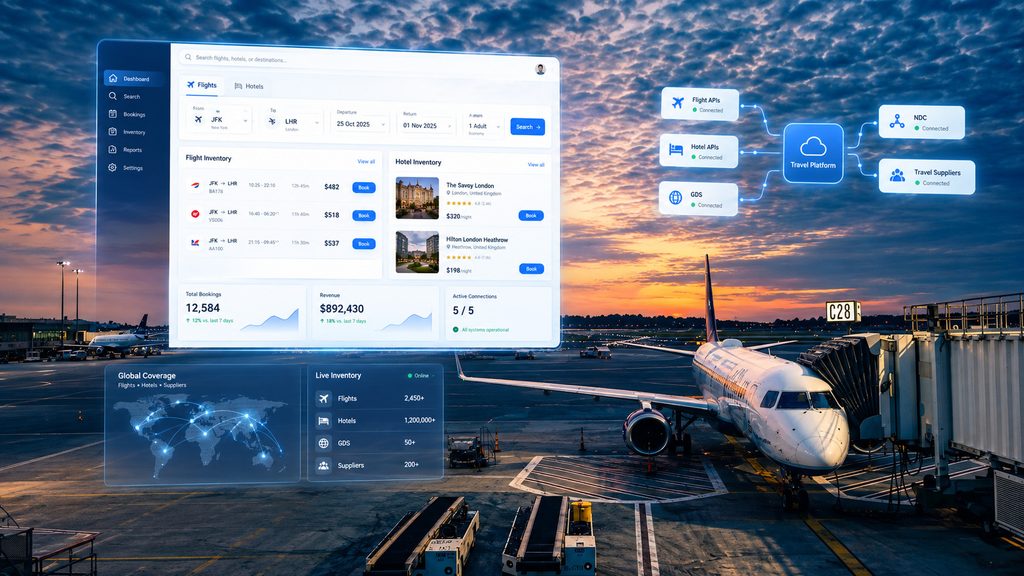
A modern online travel agency (OTA) is not simply a website with a booking form. Behind the interface is an ecosystem of APIs, supplier connections, GDS platforms, NDC content, booking engines, payment systems, inventory management and post-booking services.
If you are planning how to build an online travel agency, understanding travel API integration is one of the most important technical foundations.
A properly designed travel API integration can allow a business to connect multiple suppliers while presenting inventory through one consistent booking experience.
For airline distribution, NDC is particularly important. IATA describes NDC as an XML-based data-exchange standard built around Offer and Order management and designed to improve communication between airlines and travel sellers.
This guide explains how travel API integration works, the main API types, GDS and NDC connectivity, architecture, authentication, booking workflows, supplier management, technical challenges and how businesses can approach building a scalable travel platform.
What Is Travel API Integration?
Travel API integration is the process of connecting a travel website, OTA, booking engine, mobile application or travel management platform with external travel suppliers through application programming interfaces (APIs).
These APIs can provide access to:
- Flight inventory
- Hotel inventory
- Room availability
- Pricing
- Airline fares
- NDC offers
- GDS content
- Transfers
- Car rentals
- Tours and activities
- eSIM products
- Visa services
- Booking and reservation data
- Payment services
Instead of manually maintaining every flight or hotel in a database, a travel platform can request current information from connected suppliers.
A typical workflow looks like:
Customer → Travel Website/App → Travel API Layer → Supplier/GDS/NDC → Availability & Pricing → Booking → Confirmation
The API layer acts as the communication bridge between the customer-facing platform and external travel inventory.
Why Is Travel API Integration Important for OTAs?
An OTA needs access to a large amount of travel inventory while keeping the booking experience simple.
Without integrations, an OTA may need to manually manage:
- Airline schedules
- Hotel availability
- Room rates
- Fare rules
- Booking confirmations
- Cancellations
- Supplier updates
- Pricing changes
API connectivity automates much of this process.
Key benefits include:
1. Real-Time or Near-Real-Time Inventory
APIs can allow platforms to request current availability and pricing from suppliers rather than relying exclusively on manually maintained inventory.
2. Multiple Supplier Connectivity
A platform can integrate multiple suppliers and combine their content into one booking interface.
3. Automated Booking
Search, price validation, passenger information, reservation creation and confirmation can be connected into an automated workflow.
4. Broader Product Coverage
Travel businesses can expand beyond flights and hotels into:
- Transfers
- Activities
- Cars
- Tours
- eSIM
- Visa services
5. B2B and B2C Distribution
The same underlying technology can support consumer booking websites as well as agent portals and B2B travel platforms.
TRAVEL TECHNOLOGY PLATFORMBuilding an Online Travel Platform?
Connect flights, hotels, and travel suppliers through a scalable, API-driven travel technology architecture.
Explore TravelsOTA →How Does Travel API Integration Work?
A typical travel API workflow can be divided into several stages.
Step 1: Customer Search
The traveler enters information such as:
- Origin
- Destination
- Travel dates
- Number of passengers
- Cabin class
- Hotel destination
- Check-in/check-out dates
- Number of rooms
The frontend sends these parameters to the backend.
Step 2: API Request
The backend sends a structured request to one or more travel suppliers.
The request may contain:
- Origin and destination
- Dates
- Passenger information
- Currency
- Language
- Supplier credentials
- Search filters
Step 3: Supplier Response
The supplier returns available products, prices and related information.
For example:
Flight API Response
- Airline
- Flight number
- Departure
- Arrival
- Duration
- Fare
- Baggage
- Cabin
- Availability
Hotel API Response
- Property
- Room
- Rate
- Cancellation policy
- Meal plan
- Availability
- Taxes
Step 4: Data Normalization
Different suppliers may return information in different formats.
A travel technology layer can normalize these responses into a consistent internal structure.
For example:
Supplier A
hotel_name
Supplier B
propertyName
Supplier C
hotelDescription
The platform can map all three into:
hotel.name
This becomes particularly important when multiple suppliers are connected.
Step 5: Pricing and Markup
The platform can apply business rules such as:
- Fixed markup
- Percentage markup
- Agent-specific markup
- Customer-specific pricing
- Currency conversion
- Commission
- Promotional pricing
Step 6: Price Validation
Before booking, the platform should validate the selected offer again where required.
This reduces problems caused by price or availability changes between search and checkout.
Step 7: Booking
The customer provides the required information and completes payment.
The system sends the booking request to the supplier.
Step 8: Confirmation
The supplier returns confirmation information such as:
- Booking reference
- PNR
- Confirmation number
- Ticket number
- Voucher
- Supplier reference
The platform stores and displays the information to the customer or travel agent.
Main Types of Travel APIs
Travel API integration is not one single technology. Different APIs solve different business requirements.
Flight APIs
Flight APIs can provide access to:
- Flight search
- Availability
- Pricing
- Fare families
- Ancillaries
- Seat selection
- Booking
- Ticketing
- Reservation management
Travelport’s current TripServices Flights APIs provide REST/JSON interfaces for searching, booking and managing air reservations.
Travelport also documents dedicated search, availability and booking workflows.
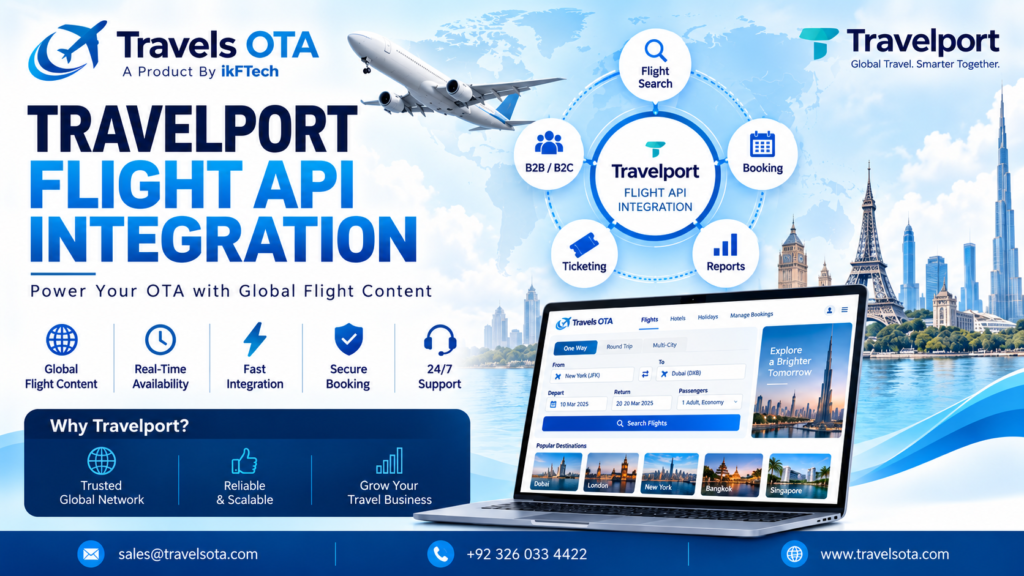
For businesses considering Travelport connectivity, see the Travelport Flight API integration guide.
Hotel APIs
Hotel APIs can connect an OTA to accommodation suppliers and provide:
- Hotel search
- Room availability
- Rates
- Room descriptions
- Images
- Amenities
- Policies
- Cancellation conditions
- Booking
- Cancellation
Hotel integration becomes more complicated when different suppliers use different property IDs, room names and content structures.
This makes hotel mapping and data normalization important parts of the integration architecture.
For a supplier-specific example, see the Hotelbeds API integration guide.
GDS APIs
A Global Distribution System (GDS) provides access to travel content and distribution capabilities used across the travel ecosystem.
A travel platform may connect to a GDS to access airline and other travel content depending on the supplier and commercial agreement.
If your team is new to GDS technology, start with what a GDS is and how it works for travel agencies.
NDC APIs
New Distribution Capability (NDC) is an IATA-supported standard based on Offer and Order management.
IATA states that NDC is an XML-based data transmission standard that enhances communication between airlines and travel sellers and is open to third parties and technology providers.
NDC covers important interactions including:
- Shopping
- Offer distribution
- Order creation
- Servicing
- Cancellation
- Payments
- Refunds
This makes NDC highly relevant for modern airline retailing.
Businesses evaluating traditional GDS and NDC approaches can also read the GDS vs NDC guide for travel agencies.
GDS vs NDC: What Is the Difference?
GDS and NDC should not automatically be treated as identical technologies.
| Area | GDS | NDC |
|---|---|---|
| Main role | Travel distribution | Airline offer/order distribution |
| Content | Depends on supplier and GDS | Airline-provided offers |
| Standard | GDS-specific technologies | IATA NDC standard |
| Offer structure | Depends on distribution channel | Offer & Order based |
| Ancillaries | Depends on content/channel | Designed to support richer airline offers |
| Integration | API/GDS connectivity | NDC APIs/messages |
| Best use | Broad distribution ecosystem | Modern airline retailing |
The exact capabilities available to an OTA depend on the supplier, airline, commercial agreement and implementation.
IATA’s current NDC documentation emphasizes Offer and Order management as the foundation of the standard.
Travel API Integration Architecture
A scalable travel platform should avoid placing every supplier integration directly inside the customer-facing frontend.
A better architecture separates the presentation layer from supplier connectivity.
Recommended architecture
Authentication and API Security
Travel APIs generally require secure authentication.
Depending on the provider, authentication can use:
- OAuth 2.0
- API keys
- Client credentials
- Tokens
- Signed requests
- Supplier-specific credentials
For example, Travelport’s current TripServices APIs use OAuth 2.0 authentication, with access tokens that are reused until expiry rather than requesting a new token for every API call.
Travel applications should also use:
- HTTPS
- Secret management
- Environment variables
- Access control
- Token rotation where applicable
- Request logging
- Monitoring
- Encryption
- Secure payment handling
API credentials should never be exposed in frontend JavaScript or publicly accessible repositories.
Travel API Search, Pricing and Booking Workflow
A reliable booking workflow generally separates discovery from final booking.
Search
Customer requests:
London → Dubai
↓
API requests supplier inventory
↓
Results returned
↓
Platform normalizes results
↓
Markup and business rules applied
↓
Customer sees available options
Price Validation
Customer selects an offer.
↓
Platform requests updated pricing/validation.
↓
System confirms whether the offer remains bookable.
Booking
Customer enters passenger/guest information.
↓
Payment is processed.
↓
Booking request is sent to supplier.
↓
Supplier returns confirmation.
↓
Booking is stored in platform database.
↓
Confirmation is displayed/sent to customer.
This separation is important because travel inventory and prices can change.
Travelport’s current booking documentation describes multiple booking approaches, including multi-request workbench workflows and Unified Checkout, with some steps varying by GDS or NDC content.
Multi-Supplier Travel API Integration
Connecting one supplier is relatively straightforward compared with managing several suppliers.
A multi-supplier platform may need to connect:
- Airline API
- GDS
- NDC
- Hotel suppliers
- Transfers
- Car rental
- Activities
- Payment gateway
- Currency service
The challenge is that every supplier may use different:
- Data formats
- Authentication
- IDs
- Error messages
- Booking workflows
- Cancellation rules
- Pricing structures
Use a Supplier Abstraction Layer
Instead of making the frontend understand every supplier’s API, create a common internal model.
For example:
Search Request
      ↓
Integration Layer
      ↓
 ┌───────────────┐
 │ Supplier A    │
 │ Supplier B    │
 │ Supplier C    │
 │ Supplier D    │
 └───────────────┘
      ↓
Normalized Response
      ↓
Booking Engine
This makes it easier to add or replace suppliers later.
Hotel Mapping and Content Normalization
Hotel APIs create a special challenge because the same property may appear differently across suppliers.
For example:
Supplier A:
The Grand Hotel Dubai
Supplier B:
Grand Hotel – Dubai
Supplier C:
GRAND HOTEL DUBAI
Without mapping, the platform could treat these as separate properties.
A hotel normalization system can map:
- Property IDs
- Room IDs
- Board types
- Amenities
- Location
- Policies
- Images
- Names
This improves search quality and reduces duplicate hotel results.
Markup Management for Travel Platforms
B2B and B2C travel businesses often need flexible pricing rules.
A platform may support:
Percentage markup
Example:
Supplier price: $100
Markup: 10%
Customer price: $110
Fixed markup
Supplier price: $100
Markup: $15
Customer price: $115
Agent-specific markup
Agent A → 5%
Agent B → 8%
Agent C → 12%
Product-specific markup
Flights → 5%
Hotels → 10%
Transfers → 15%
A centralized pricing engine can make these rules easier to manage.
Custom Solutions
Need a Custom Travel Technology Solution?
Tell us about your business model, suppliers, integrations, and growth plans. Our engineering team can build a solution designed around your specific requirements.
Request a Live DemoB2B vs B2C Travel API Platforms
Travel API architecture can support different business models.
| Feature | B2C OTA | B2B Travel Portal |
|---|---|---|
| Customer login | Traveler | Agent/company |
| Pricing | Retail | Net + markup |
| Markup | Platform-based | Agent-specific |
| Booking | Direct customer | Agent |
| Credit limits | Usually limited | Often important |
| Agent management | Not required | Core functionality |
| Reporting | Customer-focused | Agent/company-focused |
| White label | Optional | Often important |
A B2B travel portal may additionally require:
- Agent registration
- Agent approval
- Credit limits
- Balance management
- Commission
- Markup rules
- Agent-specific inventory
- Booking management
- Reporting
Payment Integration
Travel booking platforms need secure payment workflows.
Possible payment functions include:
- Card payments
- Bank payments
- Wallets
- Payment gateways
- Refunds
- Partial refunds
- Payment status
- Transaction records
The payment status should be synchronized with the booking status.
For example:
Search
 ↓
Price Check
 ↓
Booking
 ↓
Payment
 ↓
Supplier Confirmation
 ↓
Ticket / Voucher
A robust system should also define what happens if:
Payment succeeds but supplier booking fails.
This requires reconciliation and exception-handling logic rather than assuming every transaction will complete successfully.
Common Travel API Integration Challenges
1. Price Changes
Travel prices can change between search and booking.
Solution: perform appropriate price validation immediately before booking.
2. Supplier Downtime
An external API can become temporarily unavailable.
Solution: implement monitoring, retries where appropriate and supplier fallback strategies.
3. Different Data Formats
Every supplier may structure its data differently.
Solution: normalize supplier responses into a common internal model.
4. API Rate Limits
Suppliers can impose request limits.
Solution: use caching, request optimization and appropriate retry/backoff mechanisms.
5. Booking Failures
A booking can fail after payment or during supplier confirmation.
Solution: build reconciliation and exception workflows.
6. Duplicate Content
Multiple suppliers may return the same hotel or flight.
Solution: implement mapping, deduplication and normalization.
7. Currency Conversion
Different suppliers may return prices in different currencies.
Solution: centralize currency conversion and clearly store the source and converted values.
Travel API Integration Best Practices
A scalable implementation should follow these practices:
1. Use a Central Integration Layer
Avoid tightly coupling supplier APIs to the frontend.
2. Normalize Supplier Data
Create a standard internal data model.
3. Cache Carefully
Cache appropriate search/reference data without serving stale bookable inventory incorrectly.
4. Validate Prices
Always account for changes between search and booking.
5. Track Every Transaction
Use request IDs, booking references and supplier transaction identifiers.
6. Build Strong Error Handling
Errors should be categorized and logged rather than simply returned to the customer.
7. Secure Credentials
Never expose API credentials in client-side applications.
8. Monitor API Health
Track:
- Response times
- Error rates
- Supplier availability
- Booking failures
- Search-to-book conversion
- API usage
9. Design for Additional Suppliers
Your architecture should allow new supplier connectors without rewriting the entire platform.
10. Test Real Booking Workflows
Testing should cover:
- Search
- Price validation
- Passenger data
- Payment
- Booking
- Ticketing
- Cancellation
- Refund
- Failed transactions
How to Choose a Travel API Provider
Before selecting a supplier, evaluate:
| Factor | Questions to Ask |
|---|---|
| Inventory | What travel products are available? |
| Coverage | Which markets and destinations are supported? |
| API | REST, XML, SOAP or other? |
| Authentication | What authentication method is used? |
| Documentation | Is technical documentation available? |
| Sandbox | Is test access available? |
| Booking | Does the API support end-to-end booking? |
| Cancellation | Can reservations be cancelled through API? |
| Support | What technical support is provided? |
| SLA | What uptime/service commitments exist? |
| Pricing | What are setup and transaction costs? |
| Scalability | Can the provider support growing traffic? |
| NDC/GDS | What distribution channels are supported? |
The cheapest API is not necessarily the most appropriate option. The right choice depends on inventory requirements, target markets, technical architecture, commercial terms and expected booking volume.
Why Travel API Integration Should Be Scalable
A small travel startup might initially need only flight and hotel inventory.
Later, it may add:
- NDC
- GDS
- More hotel suppliers
- Tours
- Transfers
- Cars
- eSIM
- Visa services
- Mobile apps
- B2B portals
- White-label portals
Therefore, the architecture should be designed with future integrations in mind.
A modular integration architecture allows the business to expand without rebuilding the entire booking platform.
TravelsOTA for Travel Technology Solutions
TravelsOTA focuses on travel technology solutions for businesses developing or expanding online travel platforms.
The technology requirements of an OTA can involve multiple layers:
- Travel API integration
- Flight connectivity
- Hotel connectivity
- GDS integration
- NDC integration
- Booking engines
- B2B travel portals
- B2C booking platforms
- Supplier integrations
- Agent portals
- Markup management
- Payment integration
- Multi-currency support
- Travel product expansion
For example, TravelsOTA provides Travelport Flight API integration services covering flight search, pricing, booking, ticketing, reservation management and related air-booking workflows.
Businesses can also explore the TravelsOTA travel technology platform or review the TravelsOTA demo when evaluating how a travel booking solution can be structured.
Travel API Integration Checklist
Before launching a travel API integration, confirm that your platform has:
- Supplier credentials
- Sandbox environment
- Production credentials
- Secure authentication
- API gateway/integration layer
- Search functionality
- Availability handling
- Price validation
- Booking workflow
- Payment integration
- Confirmation handling
- Cancellation workflow
- Refund workflow
- Supplier error handling
- Logging
- Monitoring
- Data normalization
- Hotel mapping where required
- Currency conversion
- Markup management
- B2B/B2C access control
- Reporting
- Security testing
- Performance testing
- End-to-end booking testing
Final Thoughts
Travel API integration is the technology foundation behind many modern online travel platforms.
The objective is not simply to connect an API. A successful travel platform needs an architecture that can manage supplier connectivity, search, pricing, inventory normalization, booking, payment, cancellation, reporting and future expansion.
For airline distribution, businesses should also understand the relationship between traditional GDS connectivity and newer NDC-based Offer and Order workflows. IATA’s current NDC documentation provides the authoritative technical and industry framework for NDC.
Whether you are launching a new OTA, developing a B2B travel portal or upgrading an existing booking platform, a modular travel API architecture can provide the foundation for connecting multiple suppliers and travel products.
✈ TRAVEL TECHNOLOGY PLATFORMReady to Power Your Travel Business?
Build, launch, and scale your online travel agency with TravelsOTA’s powerful travel technology platform.
Explore TravelsOTA → View Live Demo ↗Frequently Asked Questions About Travel API Integration
1. What is travel API integration?
Travel API integration connects a travel website, application or booking platform with external suppliers such as airlines, hotels, GDS platforms, NDC providers and other travel technology services.
2. What APIs are used by online travel agencies?
OTAs can use flight APIs, hotel APIs, GDS APIs, NDC APIs, payment APIs, transfer APIs, car rental APIs, activities APIs and other supplier or service APIs.
3. What is the difference between GDS and NDC?
GDS is a distribution ecosystem used to connect travel sellers with travel content, while NDC is an IATA-supported standard focused on airline Offer and Order distribution. The exact content and capabilities depend on the supplier and implementation.
4. How long does travel API integration take?
The timeline depends on the number of suppliers, API complexity, authentication requirements, booking workflows, data mapping, payment systems and platform architecture. A simple single-supplier integration can be substantially different from a multi-supplier OTA implementation.
5. Can one travel platform integrate multiple suppliers?
Yes. A properly designed integration layer can connect multiple airline, hotel, GDS, NDC and other travel suppliers while normalizing their data into a consistent booking experience.
Keep reading

Travel Technology
B2B Travel Payments for Airlines, Travels Agencies and OTAs: A Complete Guide
B2B travel payments play a critical role in the way airlines, travel agencies, and online travel agencies (OTAs) manage bookings, supplier settlements, and international transactions. As travel businesses expand into new
Maria Zargar ·

Travel Technology
Top Travel Agencies in the World: Best Travel Companies Booking Platforms in 2026
Planning a trip today can mean choosing between a traditional travel agency, an online travel agency (OTA), a tour operator, or a specialized corporate travel company. The right option depends on what you need: flights,
Maria Zargar ·
Travel Technology
How to Build an Online Travel Agency (OTA) Platform
Building an online travel agency is no longer just about creating a website where customers can search for flights or hotels. A modern OTA needs a technology ecosystem capable of connecting travel suppliers, processing s
Maria Zargar ·
Need help with your travel platform?
Email us about booking platforms, supplier APIs, websites and mobile apps.